
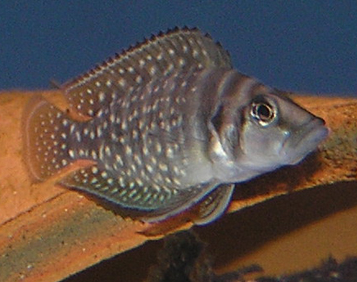

Altolamprologus calvus
Calvus is a flat-sided Lake Tanganyika cichlid that hunts fry in rock cracks. It is medium difficulty, grows to about 15 cm and needs hard, alkaline water. It is peaceful with fish too big to swallow, so skip tiny tankmates.
How it lives
- Pile rocks into caves and crevices; flowerpots or shells also work.
- Hard, alkaline tap water suits it; keep it below 28 °C.
- Do not keep it with tiny fish.
- Do not keep colour forms such as black, white and yellow together, so they cannot hybridise.
- Dim lighting makes it show itself more often.
Will it live in my water?
Type your own readings, or compare typical tap water from a few cities. The yellow pin is your water; the striped band is where it survives, the solid band is its comfort zone.
Hard going in your water
pH: outside its range. Hardness: outside its range.
Type your own readings from a test kit. Guidance, not a guarantee.Connections
Calvus in the wild
It lives only among rocks around the shores and islands of the lake. Its flat body slips into narrow gaps in the rockwork to prey on eggs, fry and small fish. Seen head on, the thin shape is hard to spot, which helps it ambush.
Calvus behaviour
Although territorial, it is generally peaceful towards fish it cannot fit in its mouth, and suits a Tanganyika community. It is shy, so avoid vigorous tankmates such as Mbuna. Julidochromis, Neolamprologus, Cyprichromis and Tanganyikan Synodontis catfish are good choices. Thick scales can be turned towards attackers and their serrated edges can do real damage.
“I kept it with tiny fish.”
What happens: They were picked off.
What to do: Its body is built to slip into gaps and take eggs, fry and small fish. Choose tankmates too big to swallow.
Similar fish
Work it out
Sources
est. marks an estimate or a figure only one source gives.
How we made this
Written with AI assistance from the sources listed here and checked against them (September 2026). Not yet reviewed by an expert. Report a mistake · How we write and check pages
Cite this page
Copy a ready-made line to credit this page in your own writing.
Citation
Scape Eden. “Calvus care: size, tank and temperature”. Scape Eden aquarium wiki, updated October 4, 2026. https://scapeeden.com/wiki/fish/altolamprologus-calvus
Reference style (APA)
Scape Eden. (2026, October 4). Calvus care: size, tank and temperature. Scape Eden. https://scapeeden.com/wiki/fish/altolamprologus-calvus
Plain link
https://scapeeden.com/wiki/fish/altolamprologus-calvus
Text and data compiled by Scape Eden are free to reuse under CC BY 4.0 with attribution (credit Scape Eden and link to this page). Photos keep their own credited licences. Records are AI-assisted drafts with cited sources: see how we write and check this.