
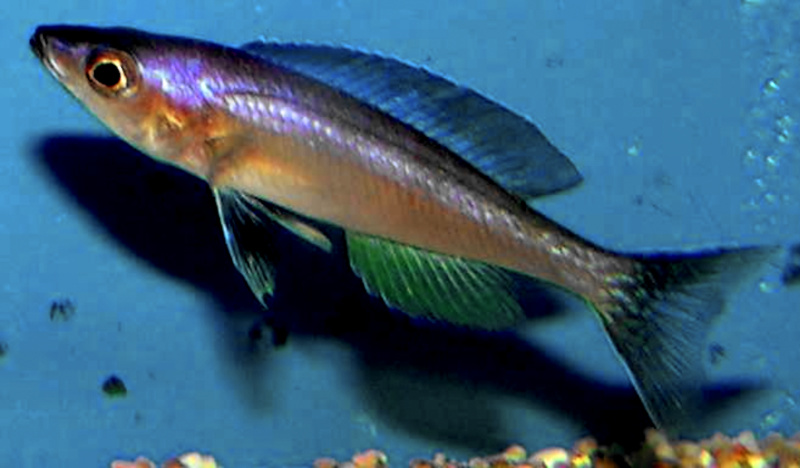

Cyprichromis leptosoma
Cyprichromis leptosoma is a slim, open-water shoaler of medium difficulty. It does best in hard, alkaline water and a tank with plenty of swimming space. Males are much more colourful than females. It is one of the favourite Tanganyikan cichlids among hobbyists.
How it lives
- Leave open swimming space; it matters more than the decor.
- Most keepers pile rocks close to the substrate in a deep tank.
- Cover the tank tightly, because males jump during spawning displays.
- Watch the first feeds closely: it has a small mouth and may miss out when newly added.
Will it live in my water?
Type your own readings, or compare typical tap water from a few cities. The yellow pin is your water; the striped band is where it survives, the solid band is its comfort zone.
Hard going in your water
pH: outside its range. Hardness: outside its range.
Type your own readings from a test kit. Guidance, not a guarantee.Connections
Tap a linked problem for causes and a step-by-step fix.
Cyprichromis in the wild
It is found only in Lake Tanganyika, in Zambia and Tanzania. It is an open-water species of the intermediate zones, with scattered rocks and sandy bottoms. In the lake it gathers in shoals of several thousand. It occurs in several geographical forms, and each comes in blue and yellow-tailed versions.
Cyprichromis behaviour
It is a very gregarious species. In larger groups, two or more alpha males may show full colour. Good tankmates are other Tanganyikans from different parts of the tank, such as rock-dwelling Julidochromis or Altolamprologus and shell-dwellers. Do not keep it with boisterous fish such as mbuna.
Similar fish
Work it out
Sources
est. marks an estimate or a figure only one source gives.
How we made this
Written with AI assistance from the sources listed here and checked against them (September 2026). Not yet reviewed by an expert. Report a mistake · How we write and check pages
Cite this page
Copy a ready-made line to credit this page in your own writing.
Citation
Scape Eden. “Cyprichromis care: size, tank and temperature”. Scape Eden aquarium wiki, updated October 8, 2026. https://scapeeden.com/wiki/fish/cyprichromis-leptosoma
Reference style (APA)
Scape Eden. (2026, October 8). Cyprichromis care: size, tank and temperature. Scape Eden. https://scapeeden.com/wiki/fish/cyprichromis-leptosoma
Plain link
https://scapeeden.com/wiki/fish/cyprichromis-leptosoma
Text and data compiled by Scape Eden are free to reuse under CC BY 4.0 with attribution (credit Scape Eden and link to this page). Photos keep their own credited licences. Records are AI-assisted drafts with cited sources: see how we write and check this.