
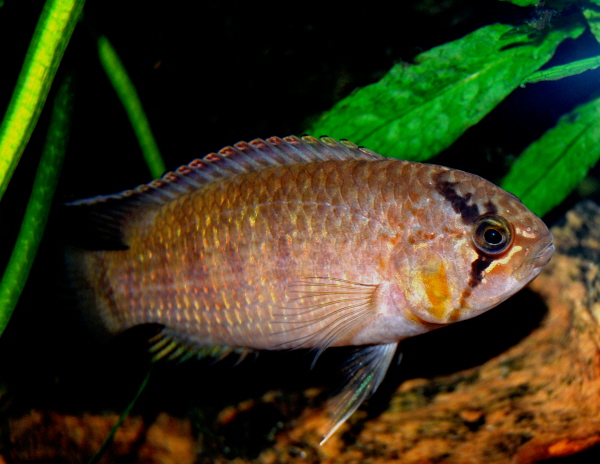

Ivanacara adoketa
Ivanacara adoketa is a small, peaceful blackwater cichlid of about 13 cm. Breeding males show bold black-and-white stripes. It is slow-moving and retiring, and easily intimidated. It needs soft, acidic water. Keep a pair.
How it lives
- Use RO water if your tap water is hard.
- Keep a pair with a cave or flat stone.
- Add dried beech, oak or Ketapang almond leaves, and replace them every few weeks.
- Use a soft sandy floor with wood roots and branches that make shady spots.
Will it live in my water?
Type your own readings, or compare typical tap water from a few cities. The yellow pin is your water; the striped band is where it survives, the solid band is its comfort zone.
Hard going in your water
pH: outside its range. Hardness: outside its range.
Type your own readings from a test kit. Guidance, not a guarantee.Connections
Tap a linked problem for causes and a step-by-step fix.
Zebra acara in the wild
It lives in rainforest streams under a dense canopy, so very little light reaches the water. The water is stained dark brown with humic acids and holds almost no minerals. The floor is littered with fallen leaves, branches and tree roots. In the wet season water rises by several metres and fish move into flooded forest.
Zebra acara: male or female?
In breeding condition the male has the bolder black-and-white stripes. Females are a more even pink, but darken their stripes when breeding or stressed. Males may also have longer dorsal and anal fins.
Zebra acara behaviour
It is slow-moving and retiring, and larger, rowdier tankmates easily intimidate it or beat it to food. Because it is rare, the emphasis should be on captive breeding, and the source recommends keeping it alone. Peaceful characins such as Hyphessobrycon, Copella or Nannostomus make good company.
Similar fish
Work it out
Sources
est. marks an estimate or a figure only one source gives.
How we made this
Written with AI assistance from the sources listed here and checked against them (September 2026). Not yet reviewed by an expert. Report a mistake · How we write and check pages
Cite this page
Copy a ready-made line to credit this page in your own writing.
Citation
Scape Eden. “Zebra acara care: size, tank and temperature”. Scape Eden aquarium wiki, updated October 9, 2026. https://scapeeden.com/wiki/fish/ivanacara-adoketa
Reference style (APA)
Scape Eden. (2026, October 9). Zebra acara care: size, tank and temperature. Scape Eden. https://scapeeden.com/wiki/fish/ivanacara-adoketa
Plain link
https://scapeeden.com/wiki/fish/ivanacara-adoketa
Text and data compiled by Scape Eden are free to reuse under CC BY 4.0 with attribution (credit Scape Eden and link to this page). Photos keep their own credited licences. Records are AI-assisted drafts with cited sources: see how we write and check this.