
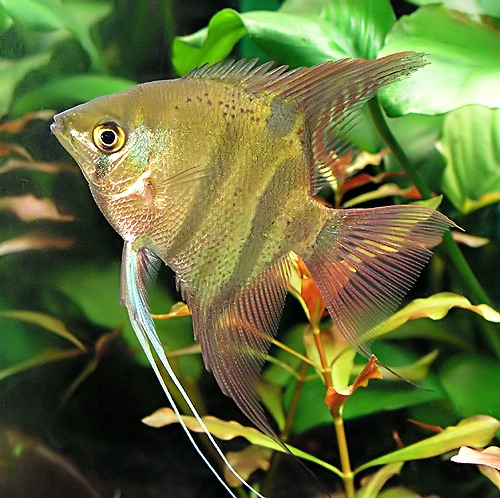

Pterophyllum leopoldi
Leopold's angelfish, also called the Roman nose angel, is a medium-difficulty cichlid that grows to about 12 cm and wants soft, acidic water. A sloping nose and up to 11 upright stripes set it apart from other angelfish. It is peaceful with other species but can bully its own kind.
How it lives
- Use RO water on hard tap, and keep nitrate low, because it copes badly with it.
- Check the label before buying: it is not the common angelfish. Look for the dark patch on the gill cover.
- Give the group tall plants such as Echinodorus, wood or leaf litter, so weaker fish can hide.
- Pick a tall tank, so the long fins have room.
- Offer pellets or flakes, plus live or frozen food.
Will it live in my water?
Type your own readings, or compare typical tap water from a few cities. The yellow pin is your water; the striped band is where it survives, the solid band is its comfort zone.
Hard going in your water
Temperature: outside what it tolerates.
Type your own readings from a test kit. Guidance, not a guarantee.Connections
Tap a linked problem for causes and a step-by-step fix.
Leopold's angelfish in the wild
In nature it lives in loose groups in slow water, often under rooty overhangs and floating plants with plenty of cover. It occurs in both clear and tea-stained water. The pH there is almost always below 7, so soft, acidic water is best for long-term care.
Leopold's angelfish: male or female?
Males tend to have longer, fancier fins and a small hump on the forehead. Females may be a little bigger in the body, so compare fish side by side. To be certain, wait for spawning. Males have small pointed genital papillae, while females are seen laying eggs.
Leopold's angelfish behaviour
It is social, and single fish get bullied in small groups. A large group spreads the aggression. Its small size means some smaller fish are not seen as prey. Medium tetras, Corydoras, suckermouth catfish and dwarf cichlids work well, and in big tanks smaller Geophagus can too.
“I mixed it up with the common angelfish.”
What happens: I gave it the wrong water, and the fish suffered.
What to do: Treat it as its own species. Keep the pH low and the water very clean.
Similar fish
Work it out
How we made this
Written with AI assistance from the sources listed here and checked against them (September 2026). Not yet reviewed by an expert. Report a mistake · How we write and check pages
Cite this page
Copy a ready-made line to credit this page in your own writing.
Citation
Scape Eden. “Leopold's angelfish care”. Scape Eden aquarium wiki, updated October 4, 2026. https://scapeeden.com/wiki/fish/pterophyllum-leopoldi
Reference style (APA)
Scape Eden. (2026, October 4). Leopold's angelfish care. Scape Eden. https://scapeeden.com/wiki/fish/pterophyllum-leopoldi
Plain link
https://scapeeden.com/wiki/fish/pterophyllum-leopoldi
Text and data compiled by Scape Eden are free to reuse under CC BY 4.0 with attribution (credit Scape Eden and link to this page). Photos keep their own credited licences. Records are AI-assisted drafts with cited sources: see how we write and check this.