
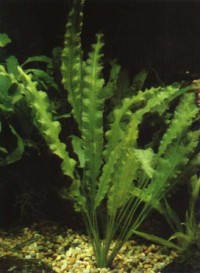

Aponogeton crispus
- GroupFlowering plant
- OrderAlismatales
- FamilyAponogetonaceae
- GenusAponogeton
Aponogeton crispus is a fast, easy bulb plant for the middle and back, 30–50 cm tall. It handles very warm water and hard tap water. Its leaves are light to olive green-brown with wavy edges, about 20–35 cm long and 6 cm wide. In aquariums it often grows for a long time without resting.
How it grows
- Bury only the roots; keep the tuber on top of the substrate.
- Use root tabs; the tuber needs reserves to survive a rest.
- If it goes bare, leave it in place with less light; it usually regrows in 4–8 weeks.
How to multiply it
Will it grow in my water?
Type your own readings, or compare typical tap water from a few cities. The yellow pin is your water; the striped band is where it survives, the solid band is its comfort zone.
Good fit for your water
All readings sit inside its range.
Type your own readings from a test kit. Guidance, not a guarantee.Where it can live
Underwater
Yes
Above water
Noest.
Frost
Keep it frost-freeest.
Nano tank
Noest.
Connections
Tap a linked problem for causes and a step-by-step fix.
Aponogeton crispus in the wild
It is native to India, Bangladesh and Sri Lanka, usually in seasonal ponds. It goes dormant in the dry season and is found in both still and running water. It is protected in Sri Lanka, where exporting it is banned under forest law, but the IUCN lists it as Least Concern. True plants never form floating leaves, and many trade plants are hybrids, often sterile. Wild plants have longer, narrower leaves than cultivated ones.
Aponogeton crispus: planting and trimming
It suits the midground or background, medium to large tanks and open layouts. It needs a mineral-rich substrate and does better in an established aquarium with nutrients. It prefers moderate to bright light from above, and added CO2 is not required. Trim older leaves close to the tuber to limit its height. Propagate it by seed or by carefully splitting the tuber.
Aponogeton crispus: why it melts or fades
It may lose its larger leaves. Dormancy is a normal, temporary phase, and growth resumes in a few weeks if the tuber is healthy. It is often grown in removable pots, which makes resting it in cooler water easier.
Varieties
| Variety | Looks like | Difficulty | Notes |
|---|---|---|---|
| 'Red' | Red-toned leaves, 30–50 cm | Easy | —est. |
| Hybrids ("wonder bulb" packs) | Mixed hybrid tubers, 30–60 cm | Easy | No CO₂ needed; 20–30 °Cest. |
Similar plants
Work it out
Sources
est. marks an estimate or a figure only one source gives.
How we made this
Written with AI assistance from the sources listed here and checked against them (September 2026). Not yet reviewed by an expert. Report a mistake · How we write and check pages
Cite this page
Copy a ready-made line to credit this page in your own writing.
Citation
Scape Eden. “Aponogeton crispus care: light, CO2 and placement”. Scape Eden aquarium wiki, updated October 7, 2026. https://scapeeden.com/wiki/plants/aponogeton-crispus
Reference style (APA)
Scape Eden. (2026, October 7). Aponogeton crispus care: light, CO2 and placement. Scape Eden. https://scapeeden.com/wiki/plants/aponogeton-crispus
Plain link
https://scapeeden.com/wiki/plants/aponogeton-crispus
Text and data compiled by Scape Eden are free to reuse under CC BY 4.0 with attribution (credit Scape Eden and link to this page). Photos keep their own credited licences. Records are AI-assisted drafts with cited sources: see how we write and check this.