
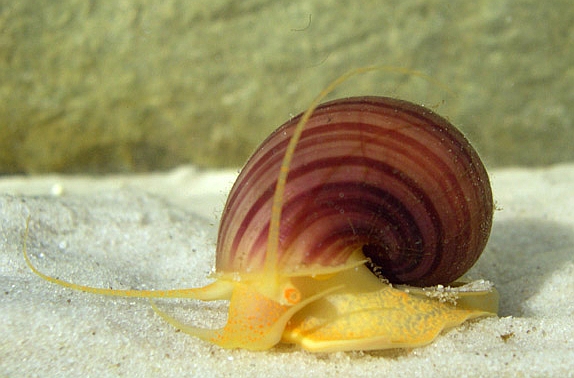

Pomacea bridgesii
Most apple snails sold as Pomacea bridgesii are really the mystery snail, Pomacea diffusa. The true species is rare and grows larger. The care on this page fits the snail you will actually buy: an easy snail of about 6.5 cm that needs an air gap under the lid and hard water.
How it lives
- Leave an air gap under a lid for egg laying.
- Give it 60 litres or more.
- Likes TDS 200–500 ppm and hard water.
- A snail sold under this name is almost always the mystery snail, Pomacea diffusa.
Will it live in my water?
Type your own readings, or compare typical tap water from a few cities. The yellow pin is your water; the striped band is where it survives, the solid band is its comfort zone.
Good fit for your water
All three readings sit inside its range.
Type your own readings from a test kit. Guidance, not a guarantee.Connections
Tap a linked problem for causes and a step-by-step fix.
Apple snail in the wild
The rare true Pomacea bridgesii is known only from the Rio Grande and the Reyes River at Beni. The common trade snail was once treated as a subspecies, P. bridgesii diffusa, found across almost the whole Amazon river system. It is now treated as its own species, Pomacea diffusa. The true bridgesii is the bigger one, with a shell 65 mm high or more. Its shell has flat-topped whorls and near-square sutures, but the mystery snail shares this shape, so it will not tell the two apart.
Apple snail behaviour
This snail is moderately amphibious. It spends the day on the bottom looking for food or hidden in mud. It is relatively inactive by day, and most of its activity comes at night.
“I trusted the label.”
What happens: It was a mystery snail, Pomacea diffusa, like most snails sold under this name.
What to do: Expect a mystery snail; the true species is rare in the wild and seldom sold.
Similar invertebrates
Work it out
Sources
- applesnail.net: care
- applesnail.net: Pomacea diffusa
- applesnail.net: Pomacea canaliculata
- USGS NAS: Pomacea diffusa
- applesnail.net Pomacea bridgesii/diffusa
- applesnail.net Pomacea diffusa
est. marks an estimate or a figure only one source gives.
How we made this
Written with AI assistance from the sources listed here and checked against them (September 2026). Not yet reviewed by an expert. Report a mistake · How we write and check pages
Cite this page
Copy a ready-made line to credit this page in your own writing.
Citation
Scape Eden. “Apple snail care: water, food and breeding”. Scape Eden aquarium wiki, updated October 4, 2026. https://scapeeden.com/wiki/inverts/pomacea-bridgesii
Reference style (APA)
Scape Eden. (2026, October 4). Apple snail care: water, food and breeding. Scape Eden. https://scapeeden.com/wiki/inverts/pomacea-bridgesii
Plain link
https://scapeeden.com/wiki/inverts/pomacea-bridgesii
Text and data compiled by Scape Eden are free to reuse under CC BY 4.0 with attribution (credit Scape Eden and link to this page). Photos keep their own credited licences. Records are AI-assisted drafts with cited sources: see how we write and check this.