
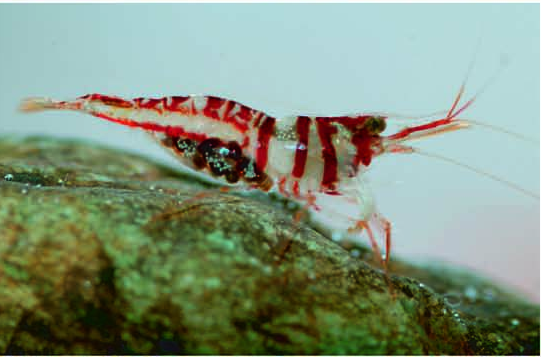

Caridina spongicola
The Harlequin shrimp lives only in the north-western arm of Lake Towuti, where it lives on an undescribed species of freshwater sponge and feeds on the diatoms growing there. It is tiny, under 1.3 cm, and one of the very few shrimp known anywhere to live on a sponge — the only one confirmed to do so in fresh water. Because both the shrimp and its sponge host are restricted to one small area of one lake, it is a conservation priority, not just a hobby curiosity.
How it lives
- It needs a live freshwater sponge in the wild it lives on nothing else, and captive success without one is unproven.
- Keep it warm and stable, matched to Lake Towuti water, and avoid any swing in parameters.
- It grazes diatoms off its sponge host rather than open rock, so do not expect it to browse biofilm like other Sulawesi shrimp.
- This is an advanced, largely unresolved husbandry challenge — expect to experiment rather than follow a settled routine.
Will it live in my water?
Type your own readings, or compare typical tap water from a few cities. The yellow pin is your water; the striped band is where it survives, the solid band is its comfort zone.
Hard going in your water
Temperature: outside what it tolerates. pH: outside its range.
Type your own readings from a test kit. Guidance, not a guarantee.Connections
Tap a linked problem for causes and a step-by-step fix.
“I bought Harlequin shrimp without a sponge, assuming they would graze rock like other Sulawesi species”
What happens: They had nothing to feed on — in the wild this shrimp is strictly tied to its freshwater sponge host and is not a generalist biofilm grazer.
What to do: Do not keep this species unless you can provide and maintain a live freshwater sponge; otherwise choose an easier Sulawesi shrimp.
Similar invertebrates
Work it out
Sources
- US Fish & Wildlife Service: Ecological Risk Screening Summary — Harlequin Shrimp
- PMC: Freshwater shrimp–sponge association from an ancient lake
- Wikipedia: Caridina spongicola
est. marks an estimate or a figure only one source gives.
How we made this
Written with AI assistance from the sources listed here and checked against them (September 2026). Not yet reviewed by an expert. Report a mistake · How we write and check pages
Cite this page
Copy a ready-made line to credit this page in your own writing.
Citation
Scape Eden. “Harlequin shrimp care: water, food and breeding”. Scape Eden aquarium wiki, updated September 29, 2026. https://scapeeden.com/wiki/inverts/caridina-spongicola
Reference style (APA)
Scape Eden. (2026, September 29). Harlequin shrimp care: water, food and breeding. Scape Eden. https://scapeeden.com/wiki/inverts/caridina-spongicola
Plain link
https://scapeeden.com/wiki/inverts/caridina-spongicola
Text and data compiled by Scape Eden are free to reuse under CC BY 4.0 with attribution (credit Scape Eden and link to this page). Photos keep their own credited licences. Records are AI-assisted drafts with cited sources: see how we write and check this.