
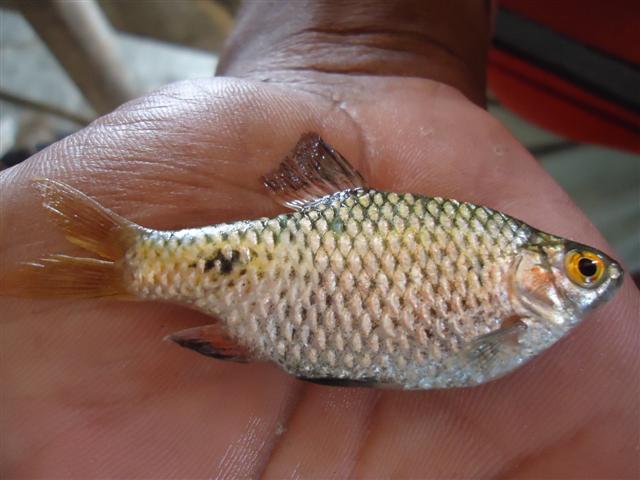

Pethia ticto
The ticto barb is an easy, peaceful barb of about 6.5 cm. It is silver with two dark spots and red in the dorsal fin. It comes from streams across South Asia and prefers cool water, because heat shortens its life. It does well in a community tank and in a hill-stream set-up.
How it lives
- Keep it below 25 °C, because heat shortens its life.
- Add floating plants and driftwood roots or branches to soften the light.
- Give it some water movement. The filter does not need to be strong.
- Use a heavily planted tank with a dark base for the best colour.
- Check the label. Its name is often given to a more colourful look-alike, and males of this one lack reddish-orange on the body.
Will it live in my water?
Type your own readings, or compare typical tap water from a few cities. The yellow pin is your water; the striped band is where it survives, the solid band is its comfort zone.
Good fit for your water
All three readings sit inside its range.
Type your own readings from a test kit. Guidance, not a guarantee.Connections
Tap a linked problem for causes and a step-by-step fix.
Ticto barb in the wild
It is widespread across the Indian subcontinent, with records from several countries. Reports from Myanmar and southern China may refer to other species. It seems most common in shallow streams and small tributaries, sometimes at high altitude, and it likes mud or silt on the bottom. Lakes and rivers with still, shallow, muddy margins also hold it. Water depth, flow and clarity probably change with the season, and many other fish live alongside it.
Ticto barb: male or female?
Adult males are slimmer than females and more colourful. The colour is strongest in the unpaired fins and the ventral fins. Rival males show their best colours when they compete for females or for rank.
Ticto barb behaviour
It is generally very peaceful and an ideal resident of a community tank. A mixed-sex group looks more natural, and other schooling fish help it feel secure. It also does well in a hill-stream style set-up.
“I kept my barbs in a warm tank.”
What happens: They lived short lives and faded.
What to do: This barb is native to streams, some at high altitude, so keep it at the cool end of its range.
Similar fish
Work it out
How we made this
Written with AI assistance from the sources listed here and checked against them (September 2026). Not yet reviewed by an expert. Report a mistake · How we write and check pages
Cite this page
Copy a ready-made line to credit this page in your own writing.
Citation
Scape Eden. “Ticto barb care: size, tank and temperature”. Scape Eden aquarium wiki, updated October 4, 2026. https://scapeeden.com/wiki/fish/pethia-ticto
Reference style (APA)
Scape Eden. (2026, October 4). Ticto barb care: size, tank and temperature. Scape Eden. https://scapeeden.com/wiki/fish/pethia-ticto
Plain link
https://scapeeden.com/wiki/fish/pethia-ticto
Text and data compiled by Scape Eden are free to reuse under CC BY 4.0 with attribution (credit Scape Eden and link to this page). Photos keep their own credited licences. Records are AI-assisted drafts with cited sources: see how we write and check this.