
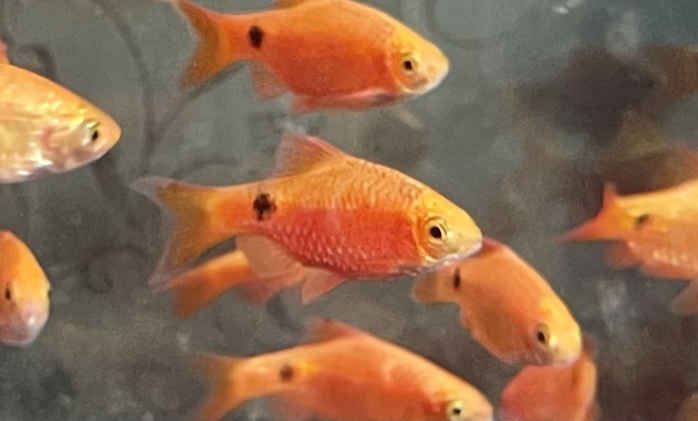

Pethia conchonius
The rosy barb is a hardy, undemanding barb from South Asia. It is a cool-water fish, happiest at 16–24 °C, so a living-room tank needs no extra heating, but avoid sudden swings. It copes with ordinary tap water and nibbles delicate plants.
How it lives
- Keep 8 or more in a tank of about 110 litres.
- Keep it cool, below 24 °C.
- Soft stem tips (such as Ludwigia) get nibbled; choose tougher plants.
- Copes with hard water.
Will it live in my water?
Type your own readings, or compare typical tap water from a few cities. The yellow pin is your water; the striped band is where it survives, the solid band is its comfort zone.
Hard going in your water
Temperature: outside what it tolerates.
Type your own readings from a test kit. Guidance, not a guarantee.Connections
Tap a linked problem for causes and a step-by-step fix.
Rosy barb in the wild
It is native to Afghanistan, Pakistan, India, Nepal and Bangladesh, and is also reported from Myanmar. It is very common in India, where small fish are sold at markets as food. It lives in lakes and fast-flowing water in a subtropical climate.
Rosy barb: male or female?
The wild-type male has a green back, a red body and black tips on the dorsal, pelvic and anal fins. The female is silvery, with only pale pink fins and no black in them. She is slightly plumper and larger, and the male is more vividly coloured. At spawning time the male flushes a rich claret and the female becomes more luminous.
Rosy barb behaviour
It is lively and often pushy. That makes it a poor match for long-finned or calm fish. Before spawning, the male chases and nudges the female's head and belly.
“I kept it at 30 °C in my planted tank”
What happens: It was stressed and ate the Ludwigia tips.
What to do: It is a cool-water fish that nibbles plants.
Varieties
| Variety | Looks like | Notes |
|---|---|---|
| Wild-type | Rosy red males | Common |
| Long-fin / Veil | Long, flowing fins | Common |
| Neon | Brighter, shiny body | Uncommon |
| Super red | Deeper red | Uncommon |
| Golden | Gold body | Uncommon |
| 'Glass' | See-through body | Uncommon |
Similar fish
Work it out
How we made this
Written with AI assistance from the sources listed here and checked against them (September 2026). Not yet reviewed by an expert. Report a mistake · How we write and check pages
Cite this page
Copy a ready-made line to credit this page in your own writing.
Citation
Scape Eden. “Rosy barb care: size, tank and temperature”. Scape Eden aquarium wiki, updated October 9, 2026. https://scapeeden.com/wiki/fish/pethia-conchonius
Reference style (APA)
Scape Eden. (2026, October 9). Rosy barb care: size, tank and temperature. Scape Eden. https://scapeeden.com/wiki/fish/pethia-conchonius
Plain link
https://scapeeden.com/wiki/fish/pethia-conchonius
Text and data compiled by Scape Eden are free to reuse under CC BY 4.0 with attribution (credit Scape Eden and link to this page). Photos keep their own credited licences. Records are AI-assisted drafts with cited sources: see how we write and check this.