
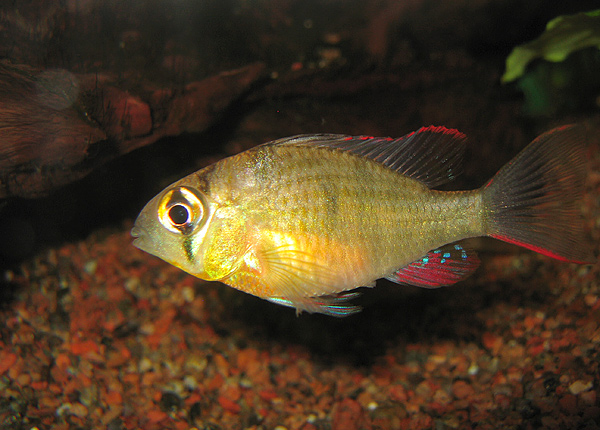

Mikrogeophagus altispinosus
The Bolivian ram is a shy, peaceful dwarf cichlid of about 8 cm, with a yellow head and front body that fade to olive-grey, and a black band through the eye. It is hardier and calmer than the German blue ram, copes with harder water and lives longer, but it prefers cooler water. Keep it as a pair or a small group.
How it lives
- It gets stressed above 27 °C.
- Keep a pair, or a group of 6 or more.
- Use fine sand so it can sift for food the way it does in the wild.
- Add dense plants or bogwood for hiding, in soft, slightly acidic water.
Will it live in my water?
Type your own readings, or compare typical tap water from a few cities. The yellow pin is your water; the striped band is where it survives, the solid band is its comfort zone.
Good fit for your water
All three readings sit inside its range.
Type your own readings from a test kit. Guidance, not a guarantee.Connections
Tap a linked problem for causes and a step-by-step fix.
Bolivian ram in the wild
It is native to the Guapore drainage in Brazil and Bolivia and the Mamore drainage in Bolivia. Wild water is soft, near-neutral and warm. The Mato Grosso fish known as two-patch were split off as a separate species in 2022.
Bolivian ram: male or female?
Males are slightly larger. They sometimes have longer extensions on the tail and dorsal fins. Adult males grow larger than females and have slightly more extended fins and more intense colour.
Bolivian ram behaviour
It swims in a stop-and-go style and mostly stays low in the tank. Aggressive, active or fast-feeding fish are poor companions. Choose calm tankmates that let it feed in peace.
“I kept it at 30 °C like my German blue rams”
What happens: It turned sluggish and got sick.
What to do: Not every ram likes heat. Keep Bolivians below 27 °C.
Varieties
| Variety | Looks like | Notes |
|---|---|---|
| Standard | Grey-gold body with a dark side spot and red-edged fins | — |
| 'Gold' / 'Blue' lines | Line-bred colour forms | Rare |
Similar fish
Work it out
Sources
est. marks an estimate or a figure only one source gives.
How we made this
Written with AI assistance from the sources listed here and checked against them (September 2026). Not yet reviewed by an expert. Report a mistake · How we write and check pages
Cite this page
Copy a ready-made line to credit this page in your own writing.
Citation
Scape Eden. “Bolivian ram care: size, tank and temperature”. Scape Eden aquarium wiki, updated October 9, 2026. https://scapeeden.com/wiki/fish/mikrogeophagus-altispinosus
Reference style (APA)
Scape Eden. (2026, October 9). Bolivian ram care: size, tank and temperature. Scape Eden. https://scapeeden.com/wiki/fish/mikrogeophagus-altispinosus
Plain link
https://scapeeden.com/wiki/fish/mikrogeophagus-altispinosus
Text and data compiled by Scape Eden are free to reuse under CC BY 4.0 with attribution (credit Scape Eden and link to this page). Photos keep their own credited licences. Records are AI-assisted drafts with cited sources: see how we write and check this.