
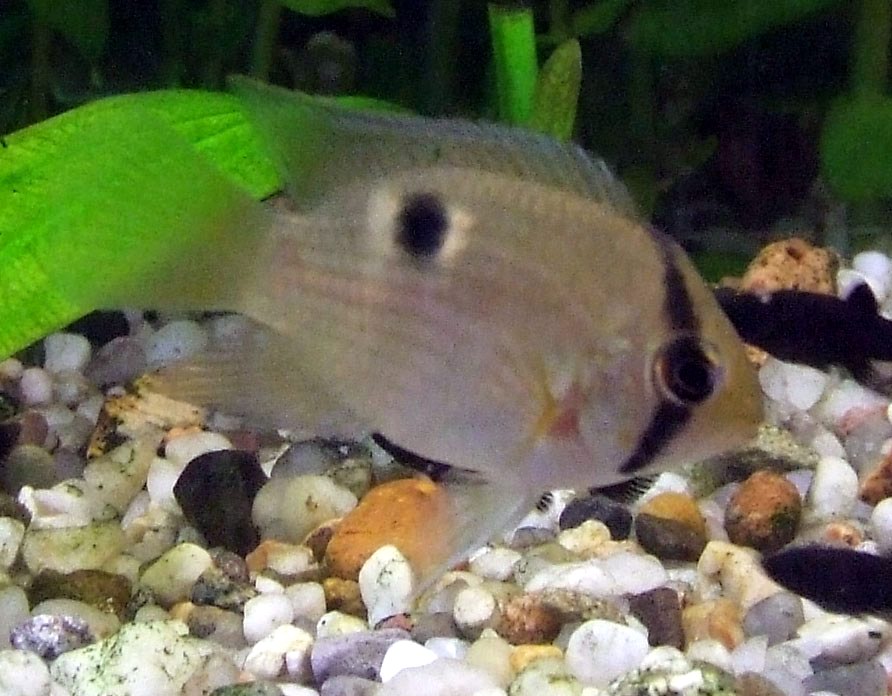

Cleithracara maronii
The keyhole cichlid is told apart by the keyhole-shaped mark on each side of its body. It is an easy, shy cichlid that stays near 10 cm and suits a calm planted tank, because it rarely digs. It prefers cooler water. Most fish in shops are farm-bred.
How it lives
- Choose gentle tankmates; avoid aggressive or territorial fish and species that need harder water.
- Give it plants, wood and caves for cover.
- Add only to a fully matured tank and keep up regular water changes, as it suffers when water quality slips.
- Place the filter return so the flow stays gentle.
Will it live in my water?
Type your own readings, or compare typical tap water from a few cities. The yellow pin is your water; the striped band is where it survives, the solid band is its comfort zone.
Good fit for your water
All three readings sit inside its range.
Type your own readings from a test kit. Guidance, not a guarantee.Connections
Tap a linked problem for causes and a step-by-step fix.
Keyhole cichlid in the wild
It was first described from the Maroni river in French Guiana and lives in most river systems there, as well as in Guyana, Suriname, the Orinoco delta of Venezuela and Trinidad. It lives in slow or still, tea-coloured streams. The water is stained by rotting plant matter and holds few dissolved minerals. The bottom is littered with leaves, branches and roots, with a few water plants in places.
Keyhole cichlid: male or female?
Young fish cannot be sexed by sight. Adult males grow considerably larger than females. Males also develop extended dorsal and anal fins. To get a pair, buy a group of youngsters and separate pairs as they form.
Keyhole cichlid behaviour
It is not aggressive unless breeding, and it will not hunt fish larger than a few millimetres. Most peaceful species that like similar water make good tankmates. Small shoaling fish such as characins help, because their presence signals that no danger is near. When it senses danger its pattern darkens and it hides among plants, wood or leaves.
“I kept it with bullies.”
What happens: It hid and wasted away; poor care can also cause head and side-line erosion or stunted growth.
What to do: Pair this shy cichlid with calm fish and keep the water clean.
Similar fish
Work it out
Sources
est. marks an estimate or a figure only one source gives.
How we made this
Written with AI assistance from the sources listed here and checked against them (September 2026). Not yet reviewed by an expert. Report a mistake · How we write and check pages
Cite this page
Copy a ready-made line to credit this page in your own writing.
Citation
Scape Eden. “Keyhole cichlid care: size, tank and temperature”. Scape Eden aquarium wiki, updated October 8, 2026. https://scapeeden.com/wiki/fish/cleithracara-maronii
Reference style (APA)
Scape Eden. (2026, October 8). Keyhole cichlid care: size, tank and temperature. Scape Eden. https://scapeeden.com/wiki/fish/cleithracara-maronii
Plain link
https://scapeeden.com/wiki/fish/cleithracara-maronii
Text and data compiled by Scape Eden are free to reuse under CC BY 4.0 with attribution (credit Scape Eden and link to this page). Photos keep their own credited licences. Records are AI-assisted drafts with cited sources: see how we write and check this.