
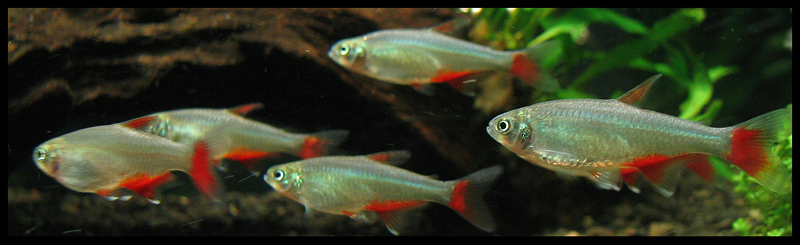

Aphyocharax anisitsi
A fast, hardy silver tetra of about 5.5 cm with blood-red fins, good for beginners. It copes with hard water and a wide temperature range, and enjoys moderate flow. It may nip and outpaces slow fish such as bettas. Keep at least 8 in 80 litres.
How it lives
- Fit a tightly closing lid; it jumps now and then.
- Plant dense areas but leave open water for swimming, and add floating plants because it uses the upper tank.
- It takes most dried, frozen and live foods.
- In a well-insulated house an unheated tank works, but colour is better in warmer water.
- Do not keep it with slow fish such as bettas.
Will it live in my water?
Type your own readings, or compare typical tap water from a few cities. The yellow pin is your water; the striped band is where it survives, the solid band is its comfort zone.
Good fit for your water
All three readings sit inside its range.
Type your own readings from a test kit. Guidance, not a guarantee.Connections
Tap a linked problem for causes and a step-by-step fix.
Bloodfin tetra in the wild
The bloodfin tetra is native to the Paraná River drainage in Brazil, Paraguay and Argentina. The first fish described came from near Asunción. In the wild it lives in streams, rivers and tributaries, mostly where floating or overhanging plants cast shade.
Bloodfin tetra: male or female?
Males are slimmer than females. As they mature, males grow small hooks on some pelvic and anal fin rays. A ripe female looks noticeably full of eggs.
Bloodfin tetra behaviour
It is peaceful enough, but it may nip a little at long-finned or slow-moving tankmates. It does well in a mixed shoal with other characins, Corydoras and small armoured catfish. Being a shoaling fish by nature, it should always live in a group.
“I kept bloodfins with a betta.”
What happens: The betta was nipped and could not get enough food.
What to do: A speed mismatch starves slow fish.
Varieties
| Variety | Looks like | Notes |
|---|---|---|
| Standard | Silver with red fins | Common |
| Long-fin | Longer red fins | Uncommonest. |
Similar fish
Work it out
How we made this
Written with AI assistance from the sources listed here and checked against them (September 2026). Not yet reviewed by an expert. Report a mistake · How we write and check pages
Cite this page
Copy a ready-made line to credit this page in your own writing.
Citation
Scape Eden. “Bloodfin tetra care: size, tank and temperature”. Scape Eden aquarium wiki, updated October 4, 2026. https://scapeeden.com/wiki/fish/aphyocharax-anisitsi
Reference style (APA)
Scape Eden. (2026, October 4). Bloodfin tetra care: size, tank and temperature. Scape Eden. https://scapeeden.com/wiki/fish/aphyocharax-anisitsi
Plain link
https://scapeeden.com/wiki/fish/aphyocharax-anisitsi
Text and data compiled by Scape Eden are free to reuse under CC BY 4.0 with attribution (credit Scape Eden and link to this page). Photos keep their own credited licences. Records are AI-assisted drafts with cited sources: see how we write and check this.