
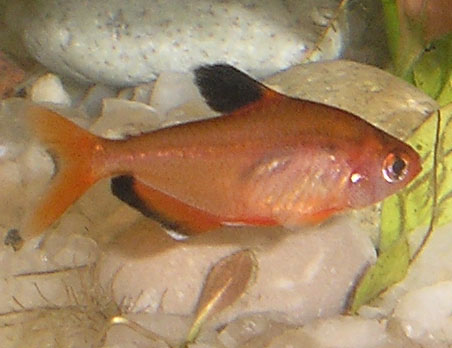

Hyphessobrycon eques
A tough, easy red tetra with a comma-shaped black shoulder spot and a body that brightens to scarlet on the flanks. It is a persistent fin nipper, worst in small groups or small tanks. Nearly all fish sold are captive bred. In 2024 the species was moved to the genus Megalamphodus.
How it lives
- Keep 12 or more in a tank of about 80 litres.
- Never keep with bettas, angelfish or other long-finned fish.
- A bigger group spreads the nipping among themselves.
- Tell the sexes by shape: males are slimmer and slightly smaller, females rounder and slightly larger.
Will it live in my water?
Type your own readings, or compare typical tap water from a few cities. The yellow pin is your water; the striped band is where it survives, the solid band is its comfort zone.
Good fit for your water
All three readings sit inside its range.
Type your own readings from a test kit. Guidance, not a guarantee.Connections
Tap a linked problem for causes and a step-by-step fix.
Serpae tetra in the wild
It is native to the Amazon, Guaporé and Paraguay River basins, with a split range that also takes in the La Plata basin. It prefers slow tributaries, floodplain lakes and flooded areas near submerged plants. It often sits near the surface between the stems of emerging plants, in stagnant water. It readily colonises artificial ponds and reservoirs.
Serpae tetra behaviour
It is gregarious and generally peaceful, but it bites fins when too many fish compete at feeding. It is widely known as aggressive toward its own kind and toward community tankmates. It belongs to the blood tetra complex, and hybrids are commonly sold.
“I kept serpaes with a betta”
What happens: They shredded its fins.
What to do: Never mix fin nippers with long-finned fish.
Varieties
| Variety | Looks like | Notes |
|---|---|---|
| Standard | Red body, black shoulder spot | Common |
| Long-fin | Longer fins | Uncommon |
| 'Red minor' | Standard serpae under a trade name | Common |
| 'Robust' wild | Wild form | Rareest. |
Similar fish
Work it out
Sources
est. marks an estimate or a figure only one source gives.
How we made this
Written with AI assistance from the sources listed here and checked against them (September 2026). Not yet reviewed by an expert. Report a mistake · How we write and check pages
Cite this page
Copy a ready-made line to credit this page in your own writing.
Citation
Scape Eden. “Serpae tetra care: size, tank and temperature”. Scape Eden aquarium wiki, updated October 7, 2026. https://scapeeden.com/wiki/fish/hyphessobrycon-eques
Reference style (APA)
Scape Eden. (2026, October 7). Serpae tetra care: size, tank and temperature. Scape Eden. https://scapeeden.com/wiki/fish/hyphessobrycon-eques
Plain link
https://scapeeden.com/wiki/fish/hyphessobrycon-eques
Text and data compiled by Scape Eden are free to reuse under CC BY 4.0 with attribution (credit Scape Eden and link to this page). Photos keep their own credited licences. Records are AI-assisted drafts with cited sources: see how we write and check this.