
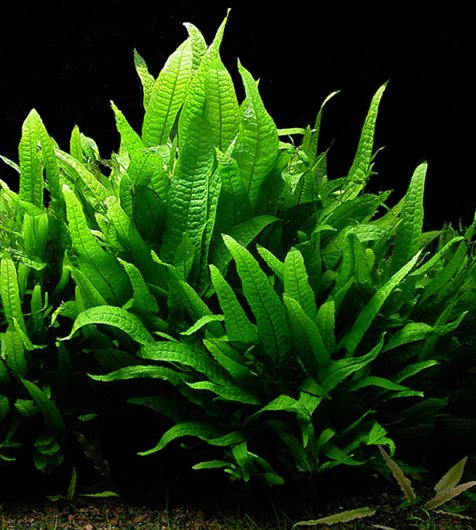

Leptochilus pteropus
- GroupFern
- OrderPolypodiales
- FamilyPolypodiaceae
- GenusLeptochilus
Also known as Polypodium pteropus, Colysis pteropus (older scientific names)
A hardy Southeast Asian fern that grows on wood or rock from a creeping rhizome. It needs little light, copes with almost any water and is too bitter for fish to eat. It makes baby plants on its old leaves.
How it grows
- Tie the rhizome to wood or rock; never bury it.
- Pull off baby plants once they are 2.5–7.5 cm with roots and tie them elsewhere.
- Even rows of dark dots under the leaves are spores, not disease.
- Feed some potassium and iron to prevent black patches.
How to multiply it
Will it grow in my water?
Type your own readings, or compare typical tap water from a few cities. The yellow pin is your water; the striped band is where it survives, the solid band is its comfort zone.
Good fit for your water
All readings sit inside its range.
Type your own readings from a test kit. Guidance, not a guarantee.Where it can live
Underwater
Yes
Above water
Yesest.
Pond
Noest.
Frost
Keep it frost-freeest.
Nano tank
Noest.
Connections
Tap a linked problem for causes and a step-by-step fix.
“I panicked at black dots under the leaves”
What happens: I cut off healthy leaves. The neat rows of brown-black dots were spore clusters, which every mature Java fern makes.
What to do: Leave even rows of dots alone. Worry only about irregular dark patches that spread from the middle of the leaf; those point to low potassium or iron, strong light, ammonia or a buried rhizome.
Varieties
| Variety | Looks like | Difficulty | Notes |
|---|---|---|---|
| 'Narrow' | Narrow leaves; 20–30 cm, sometimes to 50 | Easy | — |
| 'Windeløv' (lace) | Leaf tips fork into lacy ends; about 20 cm | Easy | — |
| 'Trident' | Leaves split into 3–5 lobes; 15–25 cm | Easy | Gets algae if the tank is dirty or bright |
| 'Needle Leaf' | Very thin leaves; about 15 cm (one source says 30) | Easy | — |
| 'Philippine' | Broad, crinkled leaves; 30–40 cm | Easy | — |
| 'Latifolia' | Broad leaves; 25–35 cm | Easy | —est. |
| 'Tropica' | Compact form; 15–20 cm | Easy | —est. |
| 'Short Narrow' | Compact narrow leaves; 10–15 cm | Easy | —est. |
| 'Mini' | Dwarf; 5–10 cm | Easy | Fits crevicesest. |
| 'Petite' | Dwarf tissue-culture form; 5–8 cm | Easy | For nano tanksest. |
Similar plants
Work it out
Sources
- Flowgrow
- Tropica
- Gensou
- Buce Plant
- Wikipedia
- Plants of the World Online (Kew)
- FishLore forum
- MonsterFishKeepers forum
- Aquasabi
- GBIF
est. marks an estimate or a figure only one source gives.
How we made this
Written with AI assistance from the sources listed here and checked against them (September 2026). Not yet reviewed by an expert. Report a mistake · How we write and check pages
Cite this page
Copy a ready-made line to credit this page in your own writing.
Citation
Scape Eden. “Java fern care: light, CO2 and placement”. Scape Eden aquarium wiki, updated September 29, 2026. https://scapeeden.com/wiki/plants/leptochilus-pteropus
Reference style (APA)
Scape Eden. (2026, September 29). Java fern care: light, CO2 and placement. Scape Eden. https://scapeeden.com/wiki/plants/leptochilus-pteropus
Plain link
https://scapeeden.com/wiki/plants/leptochilus-pteropus
Text and data compiled by Scape Eden are free to reuse under CC BY 4.0 with attribution (credit Scape Eden and link to this page). Photos keep their own credited licences. Records are AI-assisted drafts with cited sources: see how we write and check this.