
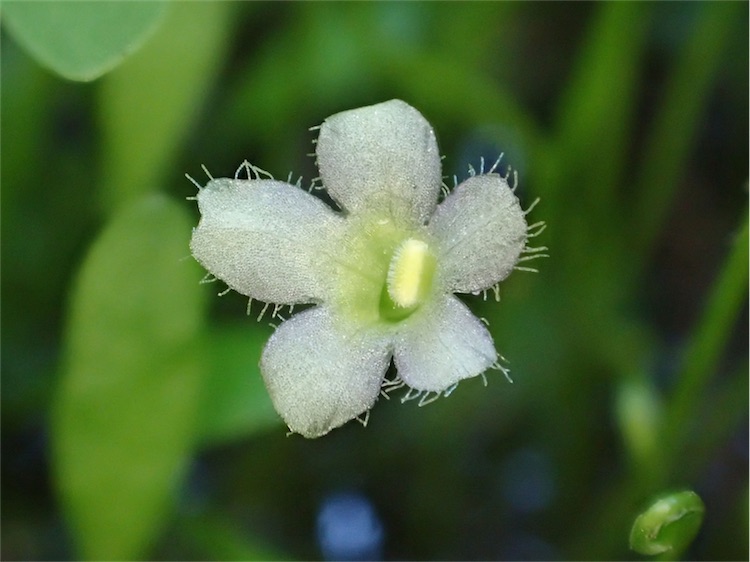

Glossostigma elatinoides
- GroupFlowering plant
- OrderLamiales
- GenusGlossostigma
Also known as Tricholoma elatinoides (older scientific name)
Glosso is a hard-to-keep carpet plant and one of the smallest aquarium plants, about 3 cm tall. Creeping runners carry spatula-shaped leaves, two at each node. Under strong light it races sideways; in weaker light the leaves stand up and it never carpets. It needs CO₂.
How it grows
- Give it strong light, at least 0.5 watts per litre, and CO₂ from the first day, and never let taller plants shade it.
- Mow it often so the layers do not stack up and rot.
- Plant it in aquasoil.
- Cut back runners that climb over neighbouring plants.
How to multiply it
Will it grow in my water?
Type your own readings, or compare typical tap water from a few cities. The yellow pin is your water; the striped band is where it survives, the solid band is its comfort zone.
Good fit for your water
All readings sit inside its range.
Type your own readings from a test kit. Guidance, not a guarantee.Where it can live
Underwater
Yes
Above water
Yes
Pond
Yesest.
Frost
Takes light frostest.
Nano tank
Yesest.
Connections
Tap a linked problem for causes and a step-by-step fix.
Glosso in the wild
It grows wild in Australia, Tasmania and New Zealand, from bogs and flood areas to riverbanks and lakeshores. It is a mat-forming perennial herb with green leaves 6–20 mm long and 1–3 mm wide. The flowers are small, two-lipped and blue-mauve. It is easy to mistake for small underwater Marsilea, but Glosso leaves come two to a node with a clear midvein, while Marsilea leaves come one to a node with fan-shaped veins.
Glosso: planting and trimming
Plant small tufts, about an eighth of a pot each, only a few centimetres apart for faster cover. Trade plants are the emersed form, so plant groups of three or four stems and wait for submersed growth. Once it appears, cut the new submersed shoots and replant them, burying each fully so that only the leaf tips stay free of the substrate. Under enough light it makes runners quickly and covers the ground in a short time.
Glosso: why it melts or fades
Nutrient shortages show on the leaves. A nitrate shortage makes leaves yellowish and older leaves drop early. A phosphate shortage slows growth sharply and turns the leaves a distinct dark green. An iron shortage causes transparent spots on the leaves.
“I gave it medium light”
What happens: The leaves stood up on long stalks and it grew upward instead of spreading.
What to do: Light decides whether a carpet grows up or out. Give Glosso strong light, or pick an easier carpet.
Similar plants
Work it out
Sources
- Tropica
- Flowgrow
- SimplyDiscus forum
- Gensou (emersed to submersed)
- GBIF
- Wikipedia: Glossostigma elatinoides
- Aquasabi Glossostigma (Wayback)
est. marks an estimate or a figure only one source gives.
How we made this
Written with AI assistance from the sources listed here and checked against them (September 2026). Not yet reviewed by an expert. Report a mistake · How we write and check pages
Cite this page
Copy a ready-made line to credit this page in your own writing.
Citation
Scape Eden. “Glosso care: light, CO2 and placement”. Scape Eden aquarium wiki, updated October 7, 2026. https://scapeeden.com/wiki/plants/glossostigma-elatinoides
Reference style (APA)
Scape Eden. (2026, October 7). Glosso care: light, CO2 and placement. Scape Eden. https://scapeeden.com/wiki/plants/glossostigma-elatinoides
Plain link
https://scapeeden.com/wiki/plants/glossostigma-elatinoides
Text and data compiled by Scape Eden are free to reuse under CC BY 4.0 with attribution (credit Scape Eden and link to this page). Photos keep their own credited licences. Records are AI-assisted drafts with cited sources: see how we write and check this.