
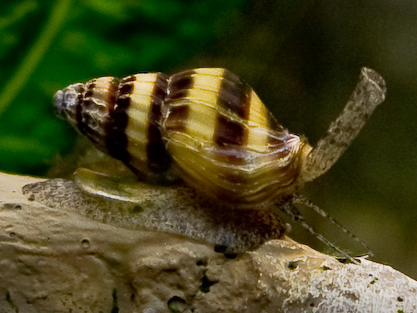

Anentome helena
The assassin snail is a carnivore that grows up to about 3 cm, usually smaller in aquariums. It has a conical shell with dark brown and yellowish-tan bands. It is easy to keep and safe with plants. Hungry ones may take shrimplets or moulting shrimp. The sexes are separate, with no visible outside difference.
How it lives
- Keep 3–6 to control pest snails. It breeds slowly, so it will not overrun the tank.
- It eats worms and snails, so keep it away from snails you want.
- It is least active at mid-day, but quickly comes out when food appears.
- Use a soft substrate, which it prefers.
- Keep it out of shrimp breeding tanks.
Will it live in my water?
Type your own readings, or compare typical tap water from a few cities. The yellow pin is your water; the striped band is where it survives, the solid band is its comfort zone.
Good fit for your water
All three readings sit inside its range.
Type your own readings from a test kit. Guidance, not a guarantee.Connections
Tap a linked problem for causes and a step-by-step fix.
Assassin snail in the wild
It is found across Southeast Asia, especially in Malaysia, Thailand and Lake Toba on Sumatra. It lives in rivers, ponds and lakes, in both standing and moving water. Its home range is tropical, in rainforest and monsoon zones.
Assassin snail behaviour
It has a fully developed mouth tube that stuns prey before it feeds. It buries itself in the substrate to ambush prey. It also extends a siphon to detect food chemicals.
“I added them to my shrimp breeding tank”
What happens: Shrimplets and freshly moulted shrimp started to go missing.
What to do: Keep assassin snails in tanks without breeding shrimp.
Similar invertebrates
Work it out
Sources
est. marks an estimate or a figure only one source gives.
How we made this
Written with AI assistance from the sources listed here and checked against them (September 2026). Not yet reviewed by an expert. Report a mistake · How we write and check pages
Cite this page
Copy a ready-made line to credit this page in your own writing.
Citation
Scape Eden. “Assassin snail care: water, food and breeding”. Scape Eden aquarium wiki, updated October 3, 2026. https://scapeeden.com/wiki/inverts/anentome-helena
Reference style (APA)
Scape Eden. (2026, October 3). Assassin snail care: water, food and breeding. Scape Eden. https://scapeeden.com/wiki/inverts/anentome-helena
Plain link
https://scapeeden.com/wiki/inverts/anentome-helena
Text and data compiled by Scape Eden are free to reuse under CC BY 4.0 with attribution (credit Scape Eden and link to this page). Photos keep their own credited licences. Records are AI-assisted drafts with cited sources: see how we write and check this.