
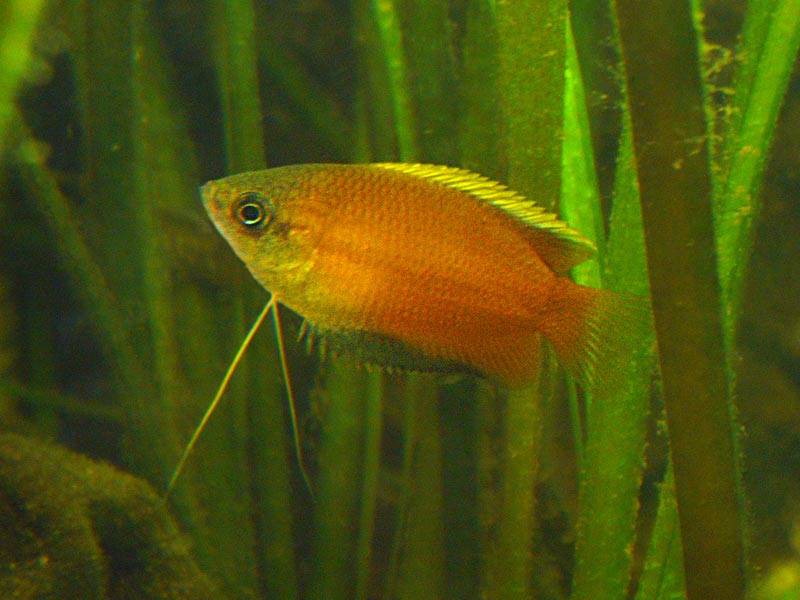

Trichogaster chuna
The honey gourami is an easy, small gourami that grows to about 5.5 cm. It is gentle and timid, so it needs calm tankmates. It is a safe swap for the dwarf gourami. Bred colour forms such as red, sunset and golden need the same care as the natural fish.
How it lives
- Keep one alone, or three or more.
- Keep it with calm fish, not with barbs. Peaceful midwater minnows and quiet loaches such as Pangio suit it.
- Keep a lid on: it breathes air and needs a warm, humid gap above the water.
- Plant the tank well with tall stems and floating plants, and add leaf litter for shade and cover.
- Give small live or frozen food such as Daphnia or bloodworm now and then for good colour.
Will it live in my water?
Type your own readings, or compare typical tap water from a few cities. The yellow pin is your water; the striped band is where it survives, the solid band is its comfort zone.
Good fit for your water
All three readings sit inside its range.
Type your own readings from a test kit. Guidance, not a guarantee.Connections
Tap a linked problem for causes and a step-by-step fix.
Honey gourami in the wild
It comes from the Ganges and Brahmaputra river systems of northern India, Bangladesh and Nepal. It lives in slow, heavily planted water such as ponds, ditches and flooded fields. Many of these places change in volume, chemistry and clarity with the monsoon rains from June to October. Nearly all fish sold today are bred for the trade, not caught wild.
Honey gourami: male or female?
Females are brownish, clearly larger than males, and have a broad brown stripe along the side. Males out of breeding mood have the same stripe, but an orange-tinted body and yellowish edges on the front of the dorsal and anal fins. Breeding males turn bright orange, with a dark blue to black head, belly front and anal fin. Males of the bred colour forms do not change like this.
Honey gourami behaviour
It is slow, and larger or livelier fish easily scare it or beat it to food. Territorial or aggressive fish are best left out. A group sorts itself into a pecking order, and dominant fish chase rivals away at feeding time. In the wild it is reported to spit water at insects resting on leaves above it to knock them down.
“I kept it with barbs”
What happens: It was bullied and hid.
What to do: Timid fish need calm tankmates.
Varieties
| Variety | Looks like | Notes |
|---|---|---|
| Wild | Honey-gold | Common. |
| Red / 'sunset' | Orange-red body | Common. |
| Gold | Bright yellow-gold body | Common. |
Similar fish
Work it out
How we made this
Written with AI assistance from the sources listed here and checked against them (September 2026). Not yet reviewed by an expert. Report a mistake · How we write and check pages
Cite this page
Copy a ready-made line to credit this page in your own writing.
Citation
Scape Eden. “Honey gourami care: size, tank and temperature”. Scape Eden aquarium wiki, updated October 9, 2026. https://scapeeden.com/wiki/fish/trichogaster-chuna
Reference style (APA)
Scape Eden. (2026, October 9). Honey gourami care: size, tank and temperature. Scape Eden. https://scapeeden.com/wiki/fish/trichogaster-chuna
Plain link
https://scapeeden.com/wiki/fish/trichogaster-chuna
Text and data compiled by Scape Eden are free to reuse under CC BY 4.0 with attribution (credit Scape Eden and link to this page). Photos keep their own credited licences. Records are AI-assisted drafts with cited sources: see how we write and check this.