
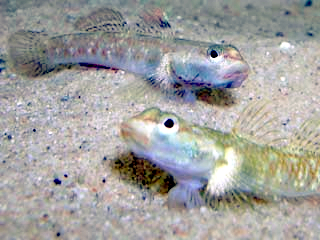

Rhinogobius duospilus
The spotted rhino goby is a small hillstream goby of about 5 cm from the streams of southern China. It clings to rocks with a sucker-like disc made from its pelvic fins. It needs current, plenty of oxygen and spotless water. It is one of the first fish to die when a filter stops. Males are more colourful, tend to grow larger and have longer unpaired fins.
How it lives
- Give it strong flow and plenty of oxygen, with airstones or a powerhead if needed.
- Add an air pump with a battery backup.
- Keep at least as many females as males, or it may turn listless.
- Do weekly water changes, since it cannot cope with built-up waste.
- Provide flat stones, slate or clay pipes as spawning caves.
Will it live in my water?
Type your own readings, or compare typical tap water from a few cities. The yellow pin is your water; the striped band is where it survives, the solid band is its comfort zone.
Good fit for your water
All three readings sit inside its range.
Type your own readings from a test kit. Guidance, not a guarantee.Connections
Tap a linked problem for causes and a step-by-step fix.
Spotted rhino goby in the wild
It was first described from Hong Kong and lives in much of southern China, including Shenzhen. Records from northern Vietnam are unconfirmed. It is a bottom dweller of small, clear hill streams with riffles and pools over stones and boulders. The water there is often slightly acidic and low in nutrients. Adults hardly move, and in one study they had moved about 3 m on average after 35 weeks. It is also sold as the white-cheeked goby.
Spotted rhino goby behaviour
Males are territorial with each other, but serious damage is unlikely when the tank has enough cover. The fish seem to need the company of their own kind. A species tank is best, or small peaceful fish that stay near the top, such as Tanichthys or Microdevario. Shrimp are likely to be eaten. Do not mix it with other Rhinogobius, as it is unclear whether they can hybridise.
“I kept it warm with no flow.”
What happens: It died at the first power cut.
What to do: A hillstream fish needs moving, oxygen-rich water, so back up the air supply.
Similar fish
Work it out
How we made this
Written with AI assistance from the sources listed here and checked against them (September 2026). Not yet reviewed by an expert. Report a mistake · How we write and check pages
Cite this page
Copy a ready-made line to credit this page in your own writing.
Citation
Scape Eden. “Spotted rhino goby care: tank size and temperature”. Scape Eden aquarium wiki, updated October 9, 2026. https://scapeeden.com/wiki/fish/rhinogobius-duospilus
Reference style (APA)
Scape Eden. (2026, October 9). Spotted rhino goby care: tank size and temperature. Scape Eden. https://scapeeden.com/wiki/fish/rhinogobius-duospilus
Plain link
https://scapeeden.com/wiki/fish/rhinogobius-duospilus
Text and data compiled by Scape Eden are free to reuse under CC BY 4.0 with attribution (credit Scape Eden and link to this page). Photos keep their own credited licences. Records are AI-assisted drafts with cited sources: see how we write and check this.