
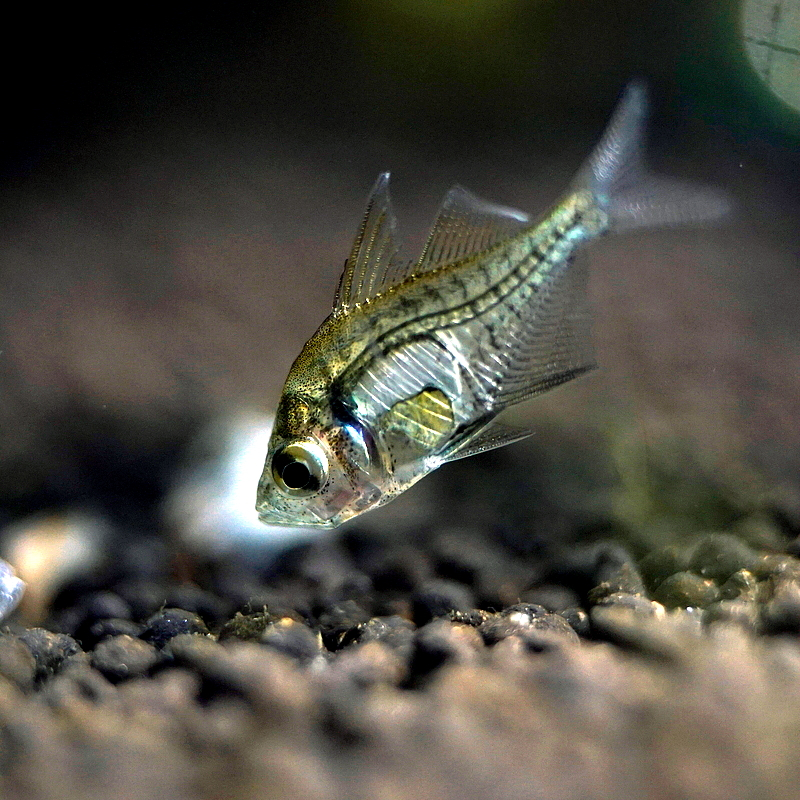

Parambassis ranga
The Indian glassy fish is an easy, peaceful, shy shoaling fish of about 8 cm. Its see-through body shows its bones and organs. It does badly alone or in pairs. Fish sold as "painted" or "disco" glassfish have been injected with dye, and most do not survive more than a few months.
How it lives
- Keep six or more with calm, bold dither fish so it comes out to eat.
- Feed live or frozen food; it also takes dried food.
- Never buy dyed or "painted" fish.
- Use a dark substrate, dense planting and floating plants to calm this shy fish.
Will it live in my water?
Type your own readings, or compare typical tap water from a few cities. The yellow pin is your water; the striped band is where it survives, the solid band is its comfort zone.
Good fit for your water
All three readings sit inside its range.
Type your own readings from a test kit. Guidance, not a guarantee.Connections
Tap a linked problem for causes and a step-by-step fix.
Indian glassy fish in the wild
It ranges from Pakistan, India and Nepal through Bangladesh and Myanmar to Thailand, Malaysia and Cambodia. It usually lives in slow-moving or still water, especially impoundments, and breeds heavily in the rainy season. In the wild it is more often found in fresh water, but it can also live in slightly brackish water.
Indian glassy fish: male or female?
Males have blue edging on the dorsal and anal fins and a slightly deeper yellow body than females. The colours become more intense when breeding. The swim bladder, which is clearly visible, has a pointed back edge in males.
Indian glassy fish behaviour
It is peaceful and shy, so avoid vigorous or aggressive tankmates. Tankmate choice also depends on the water type. In fresh water, barbs, livebearers, small rainbowfish, loaches and other small tropicals suit it. In brackish water, mollies, bumblebee gobies and chromides are possible.
“I bought dyed "painted" glassfish.”
What happens: Most did not last more than a few months.
What to do: Skip painted fish and buy natural, clear ones.
Varieties
| Variety | Looks like | Notes |
|---|---|---|
| Natural | Clear body, bluish fin edges | Common. |
Similar fish
Work it out
How we made this
Written with AI assistance from the sources listed here and checked against them (September 2026). Not yet reviewed by an expert. Report a mistake · How we write and check pages
Cite this page
Copy a ready-made line to credit this page in your own writing.
Citation
Scape Eden. “Indian glassy fish care: tank size and temperature”. Scape Eden aquarium wiki, updated October 4, 2026. https://scapeeden.com/wiki/fish/parambassis-ranga
Reference style (APA)
Scape Eden. (2026, October 4). Indian glassy fish care: tank size and temperature. Scape Eden. https://scapeeden.com/wiki/fish/parambassis-ranga
Plain link
https://scapeeden.com/wiki/fish/parambassis-ranga
Text and data compiled by Scape Eden are free to reuse under CC BY 4.0 with attribution (credit Scape Eden and link to this page). Photos keep their own credited licences. Records are AI-assisted drafts with cited sources: see how we write and check this.