
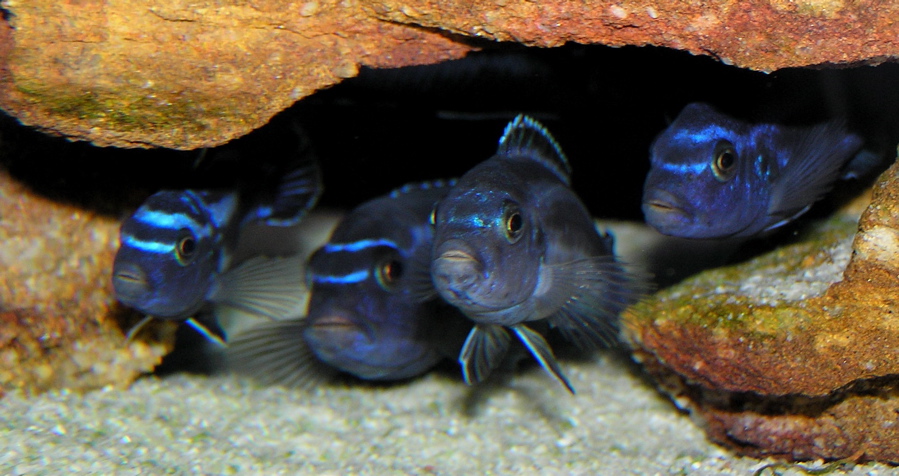

Melanochromis cyaneorhabdos
The electric blue mbuna is an easy cichlid that stays near 10 cm and lives on one stretch of rocky shore at Likoma Island. Dominant males look blue overall, which sets them apart from the black-patterned johanni. It is aggressive and territorial, so it needs a harem and a tank full of rock piles.
How it lives
- Use hard, alkaline tap water and keep it below 28 °C.
- Keep one male with three females.
- Build rock piles to the surface with a rock-only layout and sand underneath.
- Feed algae and vegetable foods, not bloodworm.
- Stock the tank fairly full so aggression is spread out.
Will it live in my water?
Type your own readings, or compare typical tap water from a few cities. The yellow pin is your water; the striped band is where it survives, the solid band is its comfort zone.
Hard going in your water
pH: outside its range. Hardness: outside its range.
Type your own readings from a test kit. Guidance, not a guarantee.Connections
Tap a linked problem for causes and a step-by-step fix.
Electric blue johanni in the wild
It is known from a single area on the northeastern shore of Likoma Island, between the points of Mbako and Membe. It lives along rocky shorelines. It was once sold under the name maingano, which came from a village on the shore where it is found.
Electric blue johanni: male or female?
Males and females look alike, so sexing is hard. The only hint is that males may grow slightly larger. Dominant males also turn blue all over, which helps tell the species from johanni.
Electric blue johanni behaviour
It is intolerant of its own kind, so one male needs several females to share his attention. Keep it with other mbuna rather than peaceful fish such as Peacocks or Utaka. Crowding the tank cuts down on territory fights. Other Melanochromis can hybridise with it, and it is often sold as an electric blue johanni by mistake.
“I added another Melanochromis to the tank.”
What happens: Related species can cross, so the young are mixed.
What to do: Keep it away from other Melanochromis and similar-looking mbuna.
Similar fish
Work it out
Sources
est. marks an estimate or a figure only one source gives.
How we made this
Written with AI assistance from the sources listed here and checked against them (September 2026). Not yet reviewed by an expert. Report a mistake · How we write and check pages
Cite this page
Copy a ready-made line to credit this page in your own writing.
Citation
Scape Eden. “Electric blue johanni care”. Scape Eden aquarium wiki, updated October 4, 2026. https://scapeeden.com/wiki/fish/melanochromis-cyaneorhabdos
Reference style (APA)
Scape Eden. (2026, October 4). Electric blue johanni care. Scape Eden. https://scapeeden.com/wiki/fish/melanochromis-cyaneorhabdos
Plain link
https://scapeeden.com/wiki/fish/melanochromis-cyaneorhabdos
Text and data compiled by Scape Eden are free to reuse under CC BY 4.0 with attribution (credit Scape Eden and link to this page). Photos keep their own credited licences. Records are AI-assisted drafts with cited sources: see how we write and check this.