
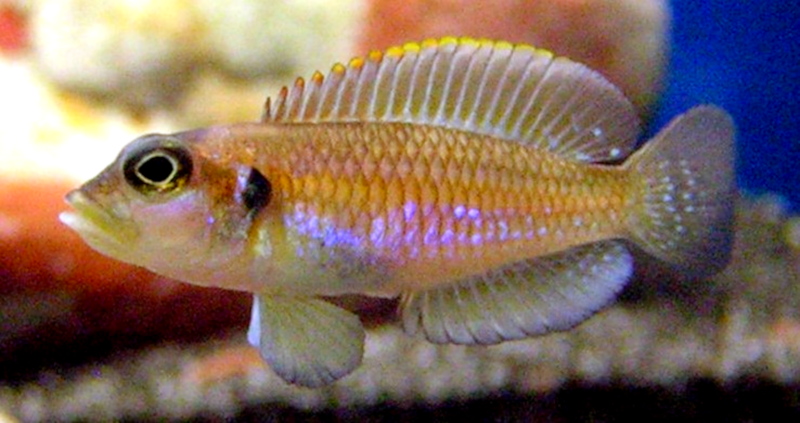

Lamprologus ocellatus
Lamprologus ocellatus is a tiny, easy shell dweller from Lake Tanganyika with a big attitude. It buries an empty snail shell in the sand and defends it hard against all comers. Males are much larger than females and have gold-edged dorsal and anal fins, while females have white edges. Keep other bottom fish away.
How it lives
- Use hard, alkaline water and keep it below 28 °C.
- Do not keep other bottom fish with it.
- Add more shells than fish and space them out to calm fights between males.
- Lay sand at least 2 inches deep, because it likes to dig.
Will it live in my water?
Type your own readings, or compare typical tap water from a few cities. The yellow pin is your water; the striped band is where it survives, the solid band is its comfort zone.
Hard going in your water
pH: outside its range. Hardness: outside its range.
Type your own readings from a test kit. Guidance, not a guarantee.Connections
Ocellatus shell dweller in the wild
It is found only in Lake Tanganyika. It lives along the shoreline among scattered rocks and open sand littered with empty snail shells. It looks like Lamprologus brevis but lacks that fish's vertical bars on the flanks.
Ocellatus shell dweller behaviour
It is territorial and defends its shell and the small patch around it with vigour. It can share with fish from other zones, such as Neolamprologus brichardi, smaller Julidochromis or open-water Cyprichromis. A larger group forms a colony. In a colony keep more females than males and provide enough shells, or fighting may get out of hand. It may also bury nearby shells so rivals cannot move in.
“I put it in with other bottom dwellers.”
What happens: It attacked them to guard its shell.
What to do: Give the pair its own patch of sand and shells, and pick tank mates from other levels.
Varieties
| Variety | Looks like |
|---|---|
| 'Gold' | Gold colour form |
Similar fish
Work it out
Sources
est. marks an estimate or a figure only one source gives.
How we made this
Written with AI assistance from the sources listed here and checked against them (September 2026). Not yet reviewed by an expert. Report a mistake · How we write and check pages
Cite this page
Copy a ready-made line to credit this page in your own writing.
Citation
Scape Eden. “Ocellatus shell dweller care”. Scape Eden aquarium wiki, updated October 9, 2026. https://scapeeden.com/wiki/fish/lamprologus-ocellatus
Reference style (APA)
Scape Eden. (2026, October 9). Ocellatus shell dweller care. Scape Eden. https://scapeeden.com/wiki/fish/lamprologus-ocellatus
Plain link
https://scapeeden.com/wiki/fish/lamprologus-ocellatus
Text and data compiled by Scape Eden are free to reuse under CC BY 4.0 with attribution (credit Scape Eden and link to this page). Photos keep their own credited licences. Records are AI-assisted drafts with cited sources: see how we write and check this.