
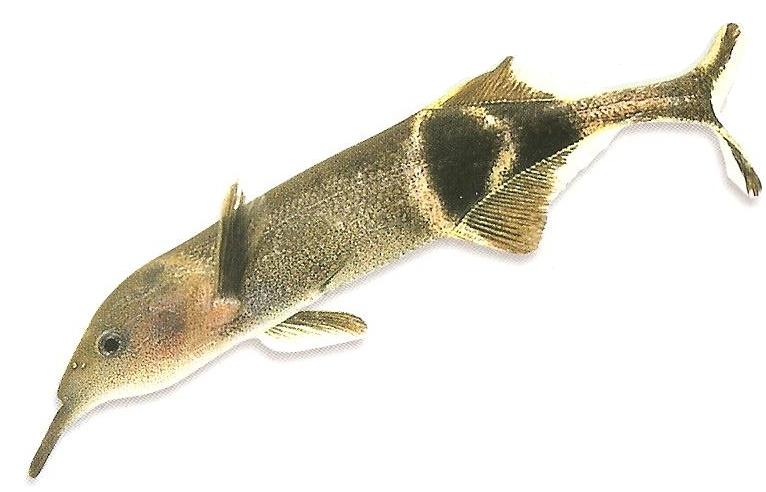

Gnathonemus petersii
The elephantnose fish is a hard-to-keep, night-active bottom fish that probes sand with a trunk-like lower lip. It is shy and peaceful to other species, but loses out at feeding time. It fights its own kind.
How it lives
- Use a smooth sand floor: sharp or coarse substrate can damage its mouth and stop it feeding.
- Dim the lights and add plenty of cover, such as smooth rocks, driftwood, Anubias or java fern.
- Keep one alone, or five or more to spread fights.
- Like other scaleless fish, it is sensitive to many aquarium medicines, including salt.
Will it live in my water?
Type your own readings, or compare typical tap water from a few cities. The yellow pin is your water; the striped band is where it survives, the solid band is its comfort zone.
Good fit for your water
All three readings sit inside its range.
Type your own readings from a test kit. Guidance, not a guarantee.Connections
Tap a linked problem for causes and a step-by-step fix.
Elephantnose fish in the wild
It has been recorded over a huge part of Africa, from Mali and Nigeria to the Congo and Zambia. It lives on dark, muddy river beds and in heavily planted areas where the water flows slowly. It prefers muddy, slow rivers and pools with cover such as sunken branches.
Elephantnose fish: male or female?
It cannot be sexed by looks, though some sources suggest anal fin shape may differ. The sexes can be told apart by the electric fields they make. That is not an option for the home aquarist.
Elephantnose fish behaviour
It is a quiet but territorial species. Do not keep it with very active or aggressive fish, because it loses at feeding time, and avoid other mormyrids. Good tankmates include butterfly fish, small bichirs, Congo tetras, Synodontis catfish and Ctenopoma, or peaceful cichlids such as Satanoperca, some Geophagus and angelfish.
“I kept it with fast feeders.”
What happens: It starved because others ate first.
What to do: Feed it after lights out, apart from fast feeders.
Similar fish
Work it out
How we made this
Written with AI assistance from the sources listed here and checked against them (September 2026). Not yet reviewed by an expert. Report a mistake · How we write and check pages
Cite this page
Copy a ready-made line to credit this page in your own writing.
Citation
Scape Eden. “Elephantnose fish care: size, tank and temperature”. Scape Eden aquarium wiki, updated October 4, 2026. https://scapeeden.com/wiki/fish/gnathonemus-petersii
Reference style (APA)
Scape Eden. (2026, October 4). Elephantnose fish care: size, tank and temperature. Scape Eden. https://scapeeden.com/wiki/fish/gnathonemus-petersii
Plain link
https://scapeeden.com/wiki/fish/gnathonemus-petersii
Text and data compiled by Scape Eden are free to reuse under CC BY 4.0 with attribution (credit Scape Eden and link to this page). Photos keep their own credited licences. Records are AI-assisted drafts with cited sources: see how we write and check this.