
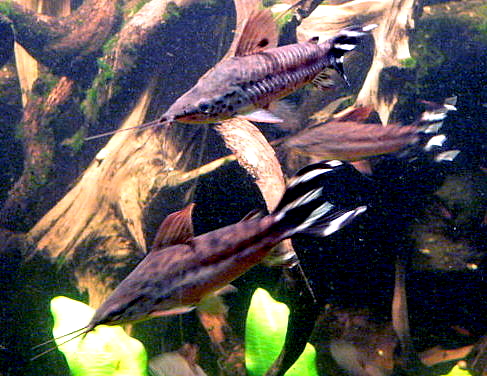

Dianema urostriatum
The porthole catfish is an armoured catfish that swims in mid-water, unlike the corys it resembles. It grows to about 12 cm and is very peaceful and will not harm even the smallest tankmates, though tiny fry may be hoovered up. A group of 5 is far more outgoing than a single fish. Newly imported wild fish can be delicate.
How it lives
- Add plenty of cover; heavily planted tanks suit it well.
- Scatter dried oak or beech leaves over a sandy floor with driftwood and roots.
- Avoid much larger or aggressive tankmates.
- Males have slightly thickened leading pectoral fin rays; females are likely rounder.
Will it live in my water?
Type your own readings, or compare typical tap water from a few cities. The yellow pin is your water; the striped band is where it survives, the solid band is its comfort zone.
Good fit for your water
All three readings sit inside its range.
Type your own readings from a test kit. Guidance, not a guarantee.Connections
Porthole catfish in the wild
It comes from parts of the Brazilian Amazon basin. It is mainly found away from the main river channels, in slower creeks, tributaries, floodplain lakes and ponds. A biotope tank would use a sandy floor with tangles of driftwood and roots.
Porthole catfish behaviour
It is a very peaceful fish that suits many communities. Good tankmates are Amazonian tetras, peaceful cichlids, Corydoras and smaller Loricariids. It is totally unaggressive towards its own kind and a little tougher than its relative Dianema longibarbis.
“I bought a single fish.”
What happens: It was less outgoing and active.
What to do: Buy a small group; they are more outgoing and active together.
Similar fish
Work it out
Sources
est. marks an estimate or a figure only one source gives.
How we made this
Written with AI assistance from the sources listed here and checked against them (September 2026). Not yet reviewed by an expert. Report a mistake · How we write and check pages
Cite this page
Copy a ready-made line to credit this page in your own writing.
Citation
Scape Eden. “Porthole catfish care: size, tank and temperature”. Scape Eden aquarium wiki, updated October 8, 2026. https://scapeeden.com/wiki/fish/dianema-urostriatum
Reference style (APA)
Scape Eden. (2026, October 8). Porthole catfish care: size, tank and temperature. Scape Eden. https://scapeeden.com/wiki/fish/dianema-urostriatum
Plain link
https://scapeeden.com/wiki/fish/dianema-urostriatum
Text and data compiled by Scape Eden are free to reuse under CC BY 4.0 with attribution (credit Scape Eden and link to this page). Photos keep their own credited licences. Records are AI-assisted drafts with cited sources: see how we write and check this.