
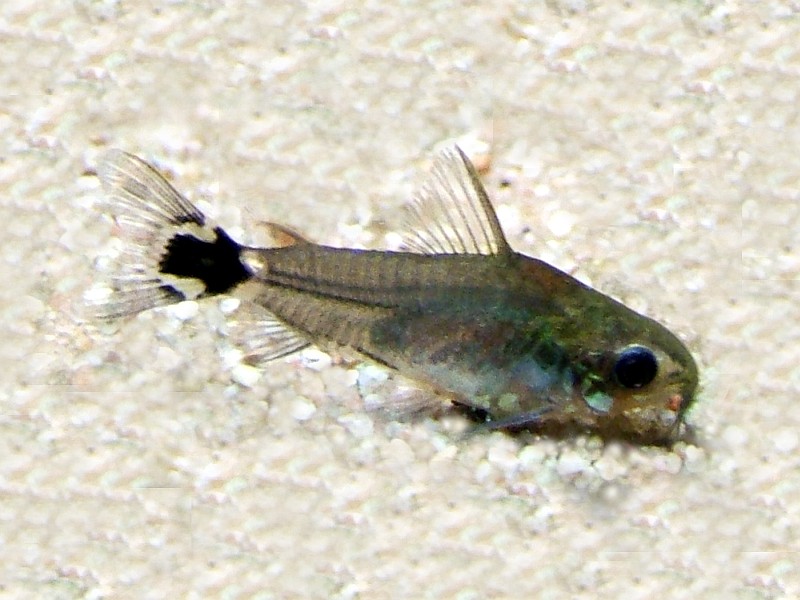

Gastrodermus hastatus
The dwarf spotted cory is a 3 cm cory that swims in mid-water like a small tetra and shows a spear-shaped spot at the base of its tail. It needs a big school to feel safe, and it does not suit rough or much larger tankmates. Females grow larger and are broader and deeper-bodied.
How it lives
- Keep 10 or more so they school.
- Keep with small, calm fish.
- Give floating plants, driftwood and leaf litter for cover.
- Offer live Daphnia and Artemia as well as sinking foods.
Will it live in my water?
Type your own readings, or compare typical tap water from a few cities. The yellow pin is your water; the striped band is where it survives, the solid band is its comfort zone.
Good fit for your water
All three readings sit inside its range.
Type your own readings from a test kit. Guidance, not a guarantee.Connections
Tap a linked problem for causes and a step-by-step fix.
Dwarf cory in the wild
It has a wider range than most corys, living in the Amazon and Paraguay basins of Argentina, Bolivia and Brazil. It was first found at Villa Bella, now Parintins, in Brazil. It is collected from backwaters, swamps, floodplain lakes and small tributaries with shallow, clear-to-cloudy water over mud and clay. Some sites have no plants and others have dense submerged grasses or floating plants.
Dwarf cory behaviour
It swims in mid-water and spends much time away from the bottom, unlike most corys. Its large eye, upturned mouth, forked tail and even body suit open water. It is peaceful but does not compete well with larger, robust fish.
“I kept a group of three.”
What happens: They hid and never schooled.
What to do: Build the group up to 10 or more so they school in open water.
Similar fish
Work it out
Sources
- PlanetCatfish
- SeriouslyFish
- Catalog of Fishes
- FishBase
- SeriouslyFish
- Guidarium: Dwarf cory (tailspot cory)
- Wikipedia
est. marks an estimate or a figure only one source gives.
How we made this
Written with AI assistance from the sources listed here and checked against them (September 2026). Not yet reviewed by an expert. Report a mistake · How we write and check pages
Cite this page
Copy a ready-made line to credit this page in your own writing.
Citation
Scape Eden. “Dwarf cory care: size, tank and temperature”. Scape Eden aquarium wiki, updated October 8, 2026. https://scapeeden.com/wiki/fish/corydoras-hastatus
Reference style (APA)
Scape Eden. (2026, October 8). Dwarf cory care: size, tank and temperature. Scape Eden. https://scapeeden.com/wiki/fish/corydoras-hastatus
Plain link
https://scapeeden.com/wiki/fish/corydoras-hastatus
Text and data compiled by Scape Eden are free to reuse under CC BY 4.0 with attribution (credit Scape Eden and link to this page). Photos keep their own credited licences. Records are AI-assisted drafts with cited sources: see how we write and check this.