
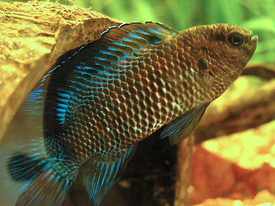

Badis badis
Badis badis is a shy, medium-difficulty micropredator of about 6 cm that can change colour rapidly, especially when breeding or stressed. Males hold small territories near the bottom. It is slow and can be intimidated or out-competed for food by bigger or pushier fish.
How it lives
- Offer small live or frozen food, because it often refuses dried food.
- Keep one male, or a pair, with caves.
- Spread the caves around the tank instead of clustering them in one spot.
- Keep it below 25 °C.
Will it live in my water?
Type your own readings, or compare typical tap water from a few cities. The yellow pin is your water; the striped band is where it survives, the solid band is its comfort zone.
Good fit for your water
All three readings sit inside its range.
Type your own readings from a test kit. Guidance, not a guarantee.Connections
Tap a linked problem for causes and a step-by-step fix.
Badis in the wild
It lives in the Ganges river system, from the Yamuna River to the delta in Bangladesh. One collection site was a wide, shallow, slow stream through rice fields, with a muddy bottom and cloudy brownish water. Other sites suggest it favours cloudy water with little flow and thick underwater plants. It is often found near water lily beds.
Badis: male or female?
Females are smaller and have a shorter, rounder body. They show no blue in the fins. Mature males grow longer dorsal, anal and tail fins. Males also darken to almost black when courting.
Badis behaviour
Do not keep it with territorial bottom fish unless the tank is very large. Never keep it with another Badis species, as they may hybridise. It is not a gregarious fish, and rival males fight, especially in tight spaces. In a roomier tank a group can work if each male can claim a territory. Shrimp such as Caridina and Neocaridina may be eaten.
“I fed it flake.”
What happens: It refused the dried food and slowly starved.
What to do: Micropredators need small live or frozen food such as Artemia or Daphnia.
Similar fish
Work it out
How we made this
Written with AI assistance from the sources listed here and checked against them (September 2026). Not yet reviewed by an expert. Report a mistake · How we write and check pages
Cite this page
Copy a ready-made line to credit this page in your own writing.
Citation
Scape Eden. “Badis care: size, tank and temperature”. Scape Eden aquarium wiki, updated October 9, 2026. https://scapeeden.com/wiki/fish/badis-badis
Reference style (APA)
Scape Eden. (2026, October 9). Badis care: size, tank and temperature. Scape Eden. https://scapeeden.com/wiki/fish/badis-badis
Plain link
https://scapeeden.com/wiki/fish/badis-badis
Text and data compiled by Scape Eden are free to reuse under CC BY 4.0 with attribution (credit Scape Eden and link to this page). Photos keep their own credited licences. Records are AI-assisted drafts with cited sources: see how we write and check this.