
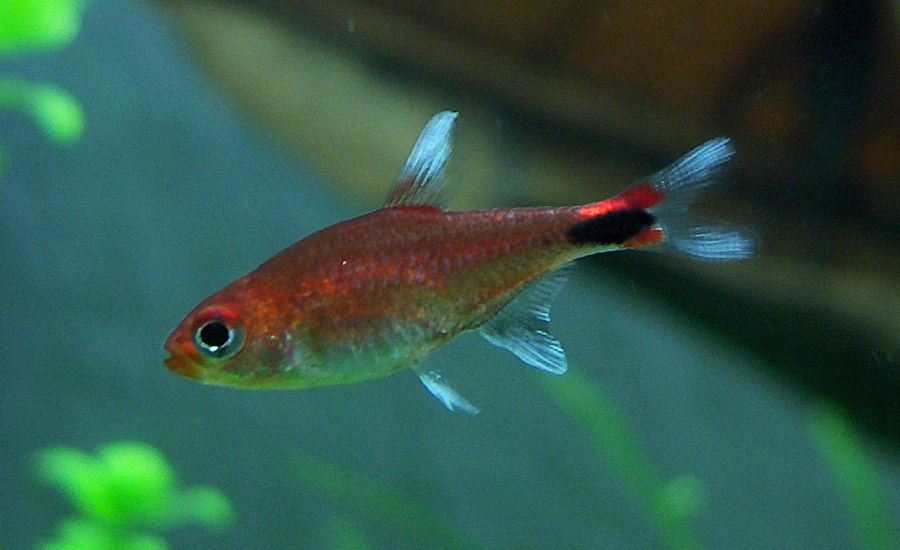

Axelrodia riesei
The ruby tetra is a tiny, glowing red tetra, about 2 cm long, from blackwater streams. It is safe with shrimp. It is hard to keep because it needs soft, acidic water and dies quickly in hard water. Its red colour apparently begins to fade once it has been in an aquarium for a while.
How it lives
- Keep 10 or more. A base of 60 x 30 cm (about 54 litres) is recommended for long-term care, though smaller tanks can be used for breeding.
- Use RO water for soft, acidic blackwater with GH under 5.
- Keep it below 26 °C.
- Use dim lighting with leaf litter, driftwood and a sandy base.
- Add floating plants such as Ceratopteris and small-leaved plants for shade.
Will it live in my water?
Type your own readings, or compare typical tap water from a few cities. The yellow pin is your water; the striped band is where it survives, the solid band is its comfort zone.
Hard going in your water
pH: outside its range. Hardness: outside its range.
Type your own readings from a test kit. Guidance, not a guarantee.Connections
Tap a linked problem for causes and a step-by-step fix.
Ruby tetra in the wild
It is known only from the upper Río Meta in Colombia, part of the Orinoco system. It is said to live in blackwater, but details are scarce. It probably lives in small forested tributaries rather than large river channels. It is seen less often in the hobby than its relative, which probably reflects its small, remote range.
Ruby tetra: male or female?
Adult males are slightly smaller and more intensely coloured than females. Mature females look rounder in the body, especially when full of eggs. The red can vary in extent between fish, and it is unclear whether those differences relate to sex.
Ruby tetra behaviour
This is a quiet, peaceful shoaling fish that seems to do best in fairly dim light. A well-structured tank with roots, branches and leaf litter gives it cover. A sandy substrate is ideal. Floating plants such as Ceratopteris add shade. Plants like Microsorum, Taxiphyllum and Cryptocoryne grow in low light and fit well.
“I added it to hard water.”
What happens: It died within weeks.
What to do: Blackwater species need blackwater. Dim light and leaf litter copy its home.
Similar fish
Work it out
How we made this
Written with AI assistance from the sources listed here and checked against them (September 2026). Not yet reviewed by an expert. Report a mistake · How we write and check pages
Cite this page
Copy a ready-made line to credit this page in your own writing.
Citation
Scape Eden. “Ruby tetra care: size, tank and temperature”. Scape Eden aquarium wiki, updated October 9, 2026. https://scapeeden.com/wiki/fish/axelrodia-riesei
Reference style (APA)
Scape Eden. (2026, October 9). Ruby tetra care: size, tank and temperature. Scape Eden. https://scapeeden.com/wiki/fish/axelrodia-riesei
Plain link
https://scapeeden.com/wiki/fish/axelrodia-riesei
Text and data compiled by Scape Eden are free to reuse under CC BY 4.0 with attribution (credit Scape Eden and link to this page). Photos keep their own credited licences. Records are AI-assisted drafts with cited sources: see how we write and check this.