
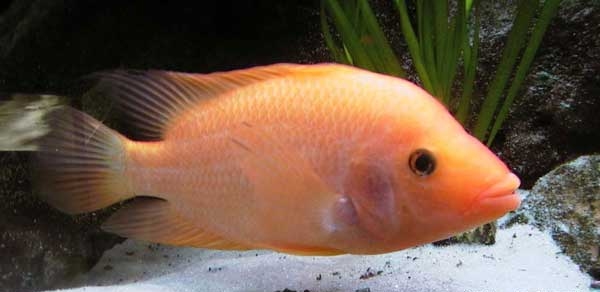

Amphilophus labiatus
One of the most aggressive cichlids, growing to 35 cm. It rebuilds the whole tank and attacks anything nearby. Even pairs can kill each other. It lives about 12 years and is often mistaken for the Midas cichlid.
How it lives
- Keep a single fish.
- Use a divider if you try to pair them.
- To get a pair, grow on several young fish together and let pairs form.
- Use heavy rocks, siliconed if needed; no plants.
- Arrange decor to block sight lines.
- Skip beefheart and other red meat.
Will it live in my water?
Type your own readings, or compare typical tap water from a few cities. The yellow pin is your water; the striped band is where it survives, the solid band is its comfort zone.
Good fit for your water
All three readings sit inside its range.
Type your own readings from a test kit. Guidance, not a guarantee.Connections
Tap a linked problem for causes and a step-by-step fix.
Red devil in the wild
It is endemic to the lakes of Nicaragua and Managua in Nicaragua, which are joined by the Tipitapa River. It stays close to submerged rocky areas and swims among the crevices. Enlarged lips are seen on some wild fish but vanish in captivity. Released fish became an invasive species in lakes of Java, Sulawesi and Papua.
Red devil: male or female?
Mature males are larger and heavier than females. They also have longer dorsal and anal fins and a bigger hump on the head. In the wild the hump shows only in breeding season, but many tank fish keep a large one all the time.
Red devil behaviour
It is among the most aggressive cichlids, including towards its own kind. In very large tanks the aggression eases, and then robust Central American cichlids or big catfish may work. Some fish tolerate no tankmates and attack everything. More than one male is not usually possible in any tank.
“I put a pair together”
What happens: The male killed the female.
What to do: Pairing monsters needs a divider until they are ready.
Varieties
| Variety | Looks like | Notes |
|---|---|---|
| Gold | Gold-yellow | — |
| Red | Red-orange | — |
| White | White | — |
| 'Blue' | Blue colour | Dyed; a welfare red lineest. |
Similar fish
Work it out
How we made this
Written with AI assistance from the sources listed here and checked against them (September 2026). Not yet reviewed by an expert. Report a mistake · How we write and check pages
Cite this page
Copy a ready-made line to credit this page in your own writing.
Citation
Scape Eden. “Red devil care: size, tank and temperature”. Scape Eden aquarium wiki, updated October 4, 2026. https://scapeeden.com/wiki/fish/amphilophus-labiatus
Reference style (APA)
Scape Eden. (2026, October 4). Red devil care: size, tank and temperature. Scape Eden. https://scapeeden.com/wiki/fish/amphilophus-labiatus
Plain link
https://scapeeden.com/wiki/fish/amphilophus-labiatus
Text and data compiled by Scape Eden are free to reuse under CC BY 4.0 with attribution (credit Scape Eden and link to this page). Photos keep their own credited licences. Records are AI-assisted drafts with cited sources: see how we write and check this.